FUSES • FUSE HOLDERS • CAR AUDIO
Fuse holders & fuses
for car amplifiers
Protect the power supply of your car audio system with
our fuses and fuse holders for car amplifiers:
ANL, Mini-ANL / AFS, AGU and various ratings for power
cables, amplifiers and high-power audio systems.
CAR AUDIO POWER PROTECTION
Fuse and fuse holder for car audio systems
The car audio fuse is an essential
component of an amplifier's power circuit. Installed in a
suitable fuse holder, it primarily protects the power
cable against overcurrent, which can occur
particularly in the event of a short circuit.
ANL
Car Audio & high power
Mini-ANL / AFS
Compact format
AGU
Cylindrical fuses
20 to 600 A
Many ratings available
CAR AUDIO FUSE TYPES
ANL, Mini-ANL / AFS & AGU
The fuse format must match the fuse holder used.
The rating must then be selected based on the cable
and the electrical configuration of the system.
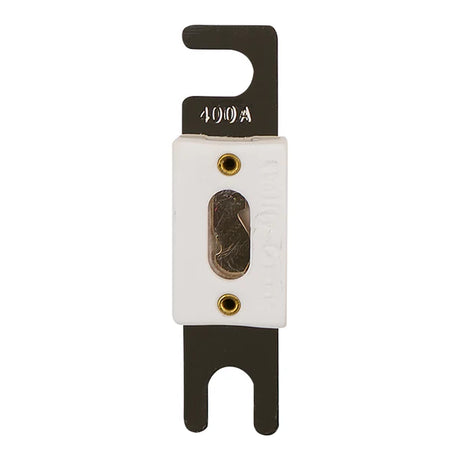
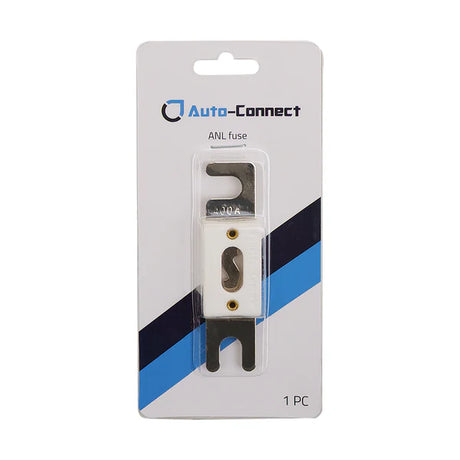
ANL fuse
The ANL fuse is widely used in car audio systems,
particularly with large-gauge cables and amplifiers
requiring significant power. Many ratings
are available for systems of different power levels.
Mini-ANL / AFS fuse
More compact than the standard ANL format, the Mini-ANL or AFS
allows for compact power supply protection.
It is used with many fuse holders and car audio
distribution blocks.
AGU fuse
The AGU fuse has a cylindrical format and is still used in
many car audio systems. It is available in
several ratings and requires an AGU-compatible fuse holder.
High-current fuses
For high-current car audio systems,
various high-current ANL fuses are available.
However, the rating should never be chosen solely
based on the amplifier's stated power.
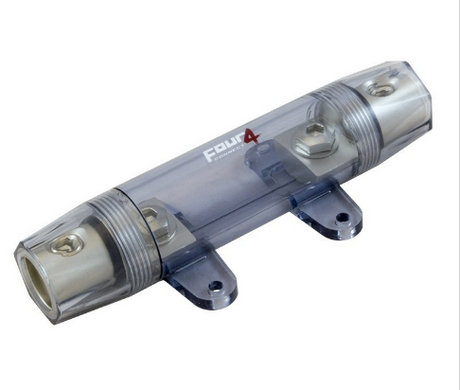
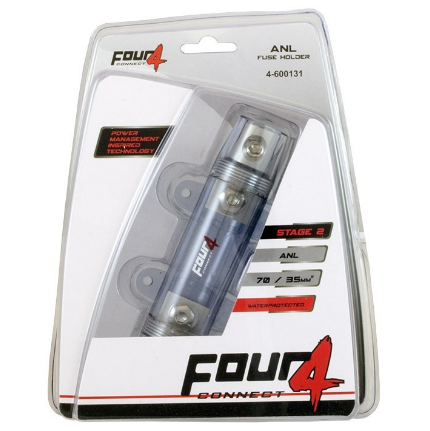
CAR AMP FUSE HOLDER
Choose a fuse holder suitable for the power cable
The fuse holder must be compatible with the type of fuse
used, but also with the cross-sectional area of the power cable.
Our selection includes models for different cable
cross-sections, as well as compact, waterproof fuse holders
and solutions suitable for high-power car audio
systems.
AVAILABLE RATINGS
Car Audio Fuses from 20 A to 600 A
Find many ratings to match the protection
to your wiring and electrical system.
20 A
Low current
30 A
Car Audio
40 A
Car Audio
60 A
Amplification
80 A
Amplification
100 A
Car amp
125 A
Car amp
150 A
High power
200 A
High power
250 A
High power
300 A
Very high power
400 A+
Powerful systems
AMPLIFIER FUSE GUIDE
Which fuse should I choose for my car amp?
The main fuse rating must be determined by taking
into account the allowable capacity of the power cable,
its cross-sectional area, length, conductor material
and the electrical requirements of the system.
✓ Cross-section — cable diameter
✓ Conductor — OFC or CCA
✓ Length — cable length
✓ Current — system current
✓ Format — ANL, AFS or AGU
✓ Fuse holder — compatible model
Not sure which rating to choose?
Contact Sound Auto Concept with your
amplifier model, the cross-section and type of cable used.
We can help you select suitable protection.
Important: the main fuse protects the cable.
Do not install an oversized fuse simply
because the amplifier is powerful. The cable located downstream
of the fuse must be able to handle the corresponding current.
The protection should be placed as close as possible to the battery
or power source to minimize the length
of unprotected positive cable.
FUSE HOLDER & CABLE CROSS-SECTION
10, 20, 35, 50 mm² and large cross-sections
Always check the cross-section accepted by the fuse holder
before purchasing.
Fuse holder 10–20 mm²
Compact models may be suitable for systems
using small or medium cross-section cables.
Check the input diameters indicated on each product.
Fuse holder 35–50 mm²
For large cross-section power supplies, use a
fuse holder designed to accept the cable diameter.
Some models accept a range of cross-sections
to accommodate multiple configurations.
HIGH-POWER CAR AUDIO
ANL fuses for powerful systems
High-power, SPL and multi-amplifier car audio
systems may require multiple protected circuits and high ratings.
Each cable and branch must be sized and protected
based on its actual electrical capacity.
FREQUENTLY ASKED QUESTIONS
FAQ – Car Audio Fuses & Fuse Holders
What is a car amplifier fuse for?
The fuse installed on the main power supply
primarily serves to protect the cable against overcurrent,
particularly in the event of a short circuit.
Which fuse should I choose for a car amplifier?
The choice depends particularly on the cross-section and material of the cable,
its length and the current required by the system.
Do not choose the rating solely based on RMS watts.
What is the difference between an ANL and Mini-ANL fuse?
The Mini-ANL or AFS is more compact than the standard ANL.
Both formats require a compatible fuse holder
for their respective size.
What is the difference between an ANL and AGU fuse?
The ANL has a flat, screw-mounted format, while the AGU
is generally cylindrical. They require different
fuse holders.
Where should I place a car amp fuse holder?
The main fuse should be installed as close as possible to the
battery or power source to minimize
the length of unprotected positive cable.
Which fuse for a 20 mm² cable?
There is no single rating applicable to all
20 mm² systems. The cable material, length,
allowable capacity and installation conditions
must be taken into account.
Which fuse for a 35 mm² or 50 mm² cable?
The rating must remain compatible with the allowable capacity
of the cable actually used. An OFC cable and a CCA cable
of the same cross-section do not necessarily have the same
electrical characteristics.
Can I use a larger fuse to prevent it from blowing?
No. Arbitrarily increasing the rating can remove
some of the cable protection. First, identify
why the fuse is blowing and check the sizing
of the system.
Do I need a fuse for each amplifier?
This depends on the wiring architecture. When a main power supply
is divided into several cables of different cross-sections,
each branch must be assessed to ensure the conductors
remain properly protected.