SPEAKERS • TWEETERS • COAXIALS • COMPONENT KITS • MIDRANGE
Car speakers & tweeters
from OEM replacement to high-power car audio
Discover our complete selection of car speakers,
tweeters, coaxial speakers, 2-way and 3-way component kits,
midrange, midrange and midbass speakers. Solutions for replacing
factory audio, improving sound quality, or building
a Hi-Fi, SQ, SQL, Show Car or high-power system.
CAR SPEAKERS & CAR AUDIO
Build your audio system around your vehicle and your goals
Speakers play an essential role in a car's
musical reproduction. Depending on their design, they can reproduce
midbass, vocals, instruments, or high frequencies.
Sound Auto Concept offers a wide range of
car audio speakers for simply upgrading
the factory system, as well as for installations using
multiple amplifiers, DSPs, high-efficiency midrange speakers
and high-power tweeters.
Coaxial
Simple & versatile
Component kits
2-way & 3-way
Midrange
Midrange & midbass
Tweeters
High frequencies & high efficiency
WHICH AUDIO SYSTEM SHOULD YOU CHOOSE?
Every car audio installation requires suitable speakers
You wouldn't choose the same speakers to simply replace
the factory ones as you would to build a Hi-Fi system
with a DSP or a high-efficiency Show Car installation.
OEM Replacement
Easily upgrade the factory audio system.
Hi-Fi / SQ
Precision, balance, and soundstage.
SQL / Show Car
Efficiency and sound levels for powerful installations.
4 MAIN CATEGORIES
Coaxial, component kit, midrange, or tweeter: which should you choose?
These speakers do not have exactly the same role.
The choice depends on the vehicle, the available space,
the amplification, and the desired sound reproduction.
Coaxial speakers
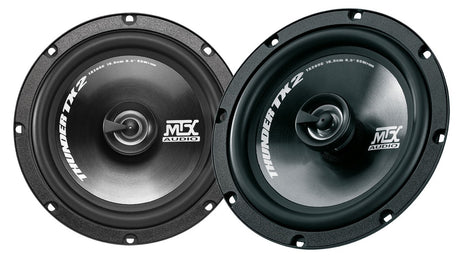
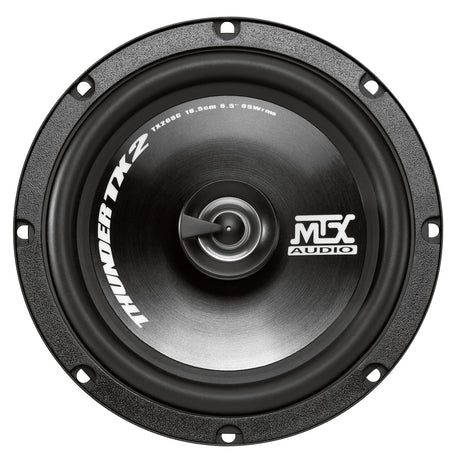
A coaxial speaker combines several drivers on the same axis,
usually a woofer or midbass driver with a tweeter.
It is a practical solution for replacing factory speakers
without installing several separate components.
Component kits
A component kit physically separates the woofer and the tweeter.
The tweeter can thus be installed higher up in the cabin.
2-way and 3-way kits are particularly interesting
for enhancing the soundstage and building a more
advanced installation.
Midrange speakers
Midrange, midrange, and midbass speakers reproduce an essential part
of vocals and instruments. High-efficiency models are also
widely used in SQL, musical SPL,
and Show Car installations requiring high sound levels.
Car Audio tweeters
Tweeters reproduce high frequencies.
They complement woofers and midrange speakers to provide
more detail, presence, and extension
in the upper part of the spectrum.
COAXIAL VS COMPONENT KIT
What difference does it make for your car?
The coaxial has the advantage of combining several drivers
in a single location. It is therefore particularly suitable
when you are looking for a simple installation.
The component kit separates the tweeter from the woofer.
This design allows the high frequencies to be placed
higher up in the cabin and offers more possibilities
for enhancing the soundstage.
However, a component kit is not automatically superior:
speaker quality, installation,
door treatment, and settings remain crucial.
CHOOSE BY DIAMETER
10, 13, 16.5, or 20 cm car speaker?
The diameter must match your location
and the role you want it to play in the system.
10 cm / 4"
Small location
13 cm / 5"
Compact format
16.5 cm / 6.5"
Major format
20 cm / 8"
Large surface
10 cm / 4-inch speaker
A compact format used in various
factory locations. It is available as coaxial
and in certain separate systems.
13 cm / 5-inch speaker
The 13 cm size is a common intermediate format.
It allows you to maintain a small footprint
while offering many models suitable
for OEM replacement or an upgraded installation.
16.5 cm / 6.5-inch speaker
The 16.5 cm size is one of the most common formats in car audio.
It is available as coaxial, component kit, woofer, midrange
and midbass, with very different power levels.
20 cm / 8-inch speaker
With a larger cone surface,
the 20 cm size is found in midbass systems,
high-efficiency speakers, and certain
custom installations.
3.5" • 4" • 5" • 6.5" • 8" • 12" • 4x6" • 5x7" • 6x8" • 6x9"
Round formats and oval speakers
The range includes many round formats,
but also oval speakers such as 4x6",
5x7", 6x8", 6x9", and certain more specific formats.
Note: two speakers listed with the same diameter
do not necessarily have the exact same dimensions.
Check the mounting diameter, mounting depth,
mounting hardware, and the space available behind the speaker.
Diameter alone does not determine performance.
A larger speaker generally has more
cone surface, but its reproduction also depends
on its motor, cone, excursion,
sensitivity, filtering, and installation.
CAR TWEETERS
Hi-Fi, dome, bullet, or high-power tweeter
Tweeters come in very different designs
depending on whether the goal is sound quality,
efficiency, or maximum sound level.
Hi-Fi / SQ tweeter
These models are particularly suitable for installations
seeking precision, detail, and integration into
a balanced soundstage.
Bullet tweeter
Bullet tweeters are frequently used
in high-efficiency installations.
Their design is focused on high efficiency
and significant projection.
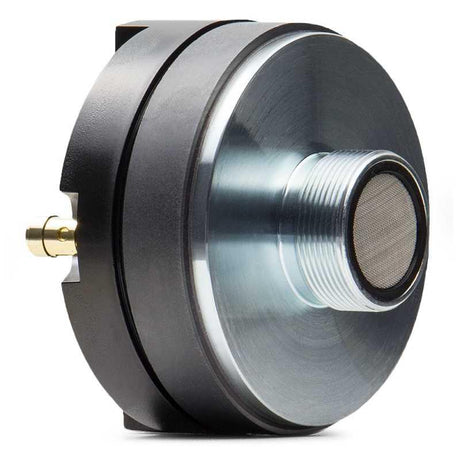
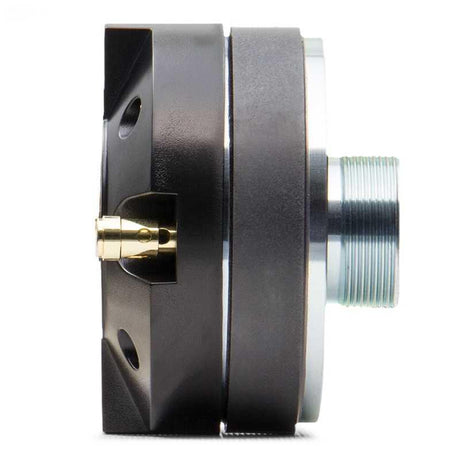
Compression / horn tweeter
Compression and horn solutions are used
when high efficiency and strong projection
are required, particularly in certain
Show Car and high-power systems.
SPL / SQL tweeter
In an installation equipped with many midrange speakers
or a very powerful low-end section, high-efficiency tweeters
maintain a sufficient level
in the high frequencies.
TWEETER FILTERING • CROSSOVER • DSP
A tweeter must be correctly filtered
A tweeter is not designed to reproduce low frequencies.
A high-pass filter or suitable crossover allows you to limit
the frequencies sent to the tweeter.
The crossover frequency and slope must be adapted
to the model used. In an active installation,
a DSP allows you to precisely set the crossovers,
levels, equalization, and delays.
Do not connect a full-range tweeter without checking its filtering.
Frequencies that are too low can cause excessive
excursion or overheating and damage the tweeter.
Always follow the manufacturer's recommendations.
MIDRANGE • MIDRANGE • MIDBASS
What is the difference between midrange and midbass?
These terms describe speakers whose operating
ranges may overlap, but whose
goals are not always identical.
Midrange / midrange
Midrange reproduces an essential part of vocals
and instruments. In high-power installations,
high-sensitivity models allow you to achieve
a high sound level with controlled power.
Midbass / midbass
A midbass is generally intended to go further
down into the low end and produce more kick.
The exact operating range, however, depends
on each speaker.
SQ • SQL • SPL • SHOW CAR
Not all speakers are designed for the same goal
An SQ installation generally prioritizes fidelity,
tonal balance, and soundstage.
An SQL installation seeks to maintain musical reproduction
while achieving a high sound level.
Demonstration-oriented or musical SPL systems may use
multiple midrange speakers and high-efficiency tweeters to match
a particularly powerful subwoofer section.
RMS POWER
40 W, 60 W, 100 W, 150 W, 200 W RMS and more
Our selection covers very different power levels,
from speakers designed to run on a car stereo
to midrange speakers and tweeters designed for heavily
amplified installations.
30–60 W RMS
Simple installation
60–100 W RMS
Versatile car audio
100–200 W RMS
Amplified system
200 W RMS+
High power
200 W RMS does not automatically mean a speaker plays louder.
RMS power mainly indicates power handling
capability. Sound level also depends on sensitivity,
amplification, filtering, the frequency range used
and the acoustic installation.
SENSITIVITY • DB • EFFICIENCY
Why is sensitivity important?
Two speakers displaying the same RMS power
can produce different sound levels.
Sensitivity gives an indication of the efficiency
with which the speaker converts electrical power
into acoustic output.
To properly compare several references,
you must, however, take into account the conditions
under which the values were measured.
IMPEDANCE
2, 3, 4, 6, or 8-Ohm speakers
Impedance is an essential element to ensure
compatibility with your car stereo or amplifier.
Simple installation
To replace an original speaker,
check the impedance of the existing system
and the compatibility of the new speaker
with the OEM head unit or amplifier.
Multi-speaker installation multi-speaker
When multiple speakers are wired
to the same channel, the series or parallel wiring
changes the final impedance seen by the amplifier.
This load must remain compatible with the amplifier used.
HEAD UNIT OR AMPLIFIER
Do you need an amplifier to change your speakers?
Not necessarily. Many coaxial speakers and component kits
can work with a head unit.
An external amplifier becomes particularly interesting
for speakers with a higher power
handling capacity and to provide more
dynamic headroom.
Always compare the actual RMS power delivered
by the amplifier to the impedance used.
An amplifier's gain is not a power or volume knob.
It is used to match the amplifier's input sensitivity
to the source signal level. Incorrect setting can promote
clipping and increase the risk of damaging the speakers.
ACTIVE SYSTEM & DSP
Take it to the next level with a DSP processor
A DSP allows you to precisely control each channel
and becomes particularly interesting in
advanced multi-way installations.
Filtering
HPF, LPF, and frequency bands tailored to each channel.
Equalization
Correct the system's response in the cabin.
Time Alignment
Work on the placement and coherence of the soundstage.
BUYING GUIDE
How to choose your car speakers?
Before choosing by brand or wattage,
check the characteristics that are truly important
for your installation.
✓ Type — coaxial, component kit, midrange, midbass, or tweeter
✓ Diameter — check the available mounting space
✓ Depth — measure the space behind the speaker
✓ RMS Power — match your amplification
✓ Sensitivity — important for efficiency
✓ Impedance — check the amplifier's load
✓ Frequencies — choose the appropriate range
✓ Filtering — passive, amplifier, or DSP
INSTALLATION • DOORS • SOUND DEADENING
A good speaker deserves a good installation
A car door is not a perfect acoustic enclosure.
Vibrations, leaks, and overly flexible supports can
limit the speaker's performance.
A rigid mounting bracket, proper fastening, and appropriate
acoustic treatment can improve the performance
of the midrange and reduce certain parasitic vibrations.
FOR WHAT PROJECT?
From the stock system to the Show Car
OEM Replacement
Coaxial speakers or component kits allow you to modernize
a stock system while maintaining a
relatively simple installation.
Hi-Fi / SQ
Component kits, amplification, and DSP allow you to
work on precision, tonal balance,
vocal placement, and the soundstage.
SQL / High Power
High-efficiency midrange and tweeters allow you to
achieve more sound level while maintaining
musical reproduction suited to the project.
Show Car
Systems using multiple midrange,
midbass, and tweeters require a precise study
of impedances, amplifiers, filtering,
and electrical requirements.
MAJOR CAR AUDIO BRANDS
Ground Zero, Rockford Fosgate, Gladen, Hertz, DD Audio & more
Find Ground Zero Audio, Rockford Fosgate,
Gladen, Hertz, Hifonics, DD Audio, Alpine,
Audison, Focal, MTX Audio, ESX Car Audio,
GAS Audio Power, Bass Habit, Reiss Audio,
Deaf Bonce, Musway, JBL, DLS, AI-Sonic,
SP Audio, Vibe Audio, and many other brands
at Sound Auto Concept.
FREQUENTLY ASKED QUESTIONS
FAQ – Car Speakers & Tweeters
Which speakers should I choose to improve my car's sound?
First, check the dimensions and impedance of the stock system.
For a simple installation, a coaxial may be suitable.
A component kit offers more possibilities for working
on tweeter placement and the soundstage.
What speaker size should I choose?
10, 13, and 16.5 cm formats are very common,
but the correct size depends on the vehicle.
Check the cutout diameter, depth, and mounting.
What is the difference between coaxial and component kits?
The coaxial combines several drivers in the same location.
The component kit separates the woofer and tweeter
so they can be positioned independently.
What is the difference between midrange, midbass, and tweeters?
The midbass generally works at lower frequencies and provides kick,
the midrange reproduces much of the vocals and instruments,
while the tweeter completes the high frequencies.
Do you need an amplifier for new speakers?
Not necessarily. Some models work with a head unit.
However, a suitable amplifier allows you to better utilize
speakers that require more power.
How do I choose an amplifier's power?
Compare the speakers' RMS power with the RMS power
delivered by the amplifier at the correct impedance.
Do not base the choice on MAX or Peak values.
Does a 200 W RMS speaker play louder than a 100 W RMS?
Not necessarily. Sensitivity, efficiency,
frequency range, installation, and actually
applied power also influence the sound level.
Must a tweeter always be filtered?
Yes, it must be protected from frequencies that are too low
with filtering suited to its characteristics
and the manufacturer's recommendations.
What is a Car Audio DSP used for?
A DSP allows you to manage filters,
equalization, levels, and delays for each channel
to optimize the system in the cabin.
Should the doors be soundproofed?
It is not mandatory, but rigid mounting
and appropriate acoustic treatment can reduce
certain vibrations and improve the performance
of speakers installed in the doors.
Can you install multiple midrange speakers on the same amplifier?
Yes, provided that the wiring produces an impedance
compatible with the amplifier and that the available power
is suited to all the speakers.